
PART ONE — The Landing
The vibration wasn’t a rumble; it was a frequency that made Tyler’s teeth itch.
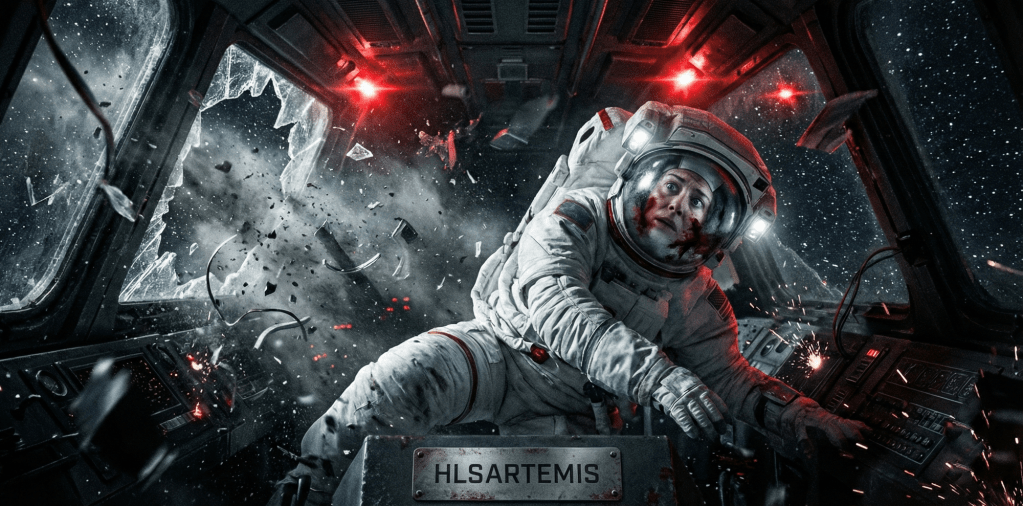
She stood strapped into the flight restraint of the HLS Artemis, a stainless-steel silo that felt less like a spaceship and more like a grain elevator dropped from orbit. This wasn’t the cramped, tin-foil closet her grandfather’s generation flew in. The flight deck of the Starship was cavernous, a hollow cathedral of brushed metal and touch-screens that hummed with a headache-inducing blue light. You could play tennis in here if gravity wasn’t currently trying to flatten your eyeballs.
“Touchdown in thirty seconds. Descent rate nominal,” the ship’s AI announced. It had a voice like a polite British butler who didn’t care if you lived or died.
Tyler tried to shift her weight, but the AxEMU suit wouldn’t let her. It wasn’t the pumpkin-orange flight suit from the old reels. It was a white, carapace-like beast, rear-entry, meaning she had crawled into it through a backpack hatch like a hermit crab finding a shell. It was supposed to be the “Ferrari of spacesuits,” according to the brochure. High-mobility joints, custom-molded gloves, a Heads-Up Display that projected her vitals directly onto the gold-coated visor.
Right now, the Ferrari smelled like ozone and the antiseptic wipe she’d used to clean her neck sweat.
She looked out the window. That was the other difference. The Apollo guys had tiny triangular portholes. She had a panoramic bay window that stretched floor-to-ceiling.
Through the glass, the Moon wasn’t a distant object anymore. It was a wall. A rushing, blurred wall of grey concrete rising up to smash them.
“Contact light,” Tyler whispered, mocking the history books. “Engine stop.”
The massive Raptor engines underneath them cut out. The silence that followed was heavier than the G-force. It slammed into the cabin, instant and absolute. The dust outside, kicked up by their exhaust, swirled in the vacuum like angry ghosts, obscuring the view for a heartbeat before settling.
“Eagle Two, this is Houston. Telemetry confirms touchdown. Welcome to Shackleton Crater.”
“Copy, Houston.” Tyler didn’t feel triumphant. She felt heavy. The gravity return—one-sixth of Earth’s—was enough to make her stomach drop. Her HUD flickered, scrolling through a list of system checks in neon green text that hovered over the desolate landscape outside.
Oxygen: 98%. Battery: 100%. Heart Rate: 110.
“Calm down,” she told the readout.
She unbuckled from the flight stand, the suit joints grinding—a sound like two bricks rubbing together. She floated/walked toward the window, her magnetic boots clanking on the metal grating.
The view was terrifying. The crater rim towered above them, a jagged mountain range of eternal shadow. The sun here was a spotlight, harsh and unforgiving, bleaching the ground white and turning the shadows into voids. There was no color. Just high-contrast static.
“It looks like a parking lot after a bomb went off,” she muttered.
“Say again, Eagle Two?”
“I said the view is… distinct, Houston.”
She turned away from the window. The vast empty space of the Starship deck felt wrong. It was too clean. Too empty. Just her, the buzzing screens, and the smell of wet copper inside her helmet.
The itch started right under the left shoulder blade, exactly where the bio-sensor adhesive had balled up into a hard, sweaty knot. It wasn’t a noble pain. It was a nagging, stupid sensation that made Tyler want to ram her back against the command console until something snapped.
“Eagle Two, you are go for EVA prep. All systems green on our end. Over.”
The voice in her ear was too loud. A jagged crackle that felt like someone was ripping paper inside her skull. Tyler didn’t answer immediately. She was staring at a smudge of grease on the instrument panel, right next to the altimeter. How did that get there? Did I eat a burger in here? No, that’s impossible. It was driving her nuts.
“Eagle Two, do you copy? Over.”
“Copy, Houston,” she said, her tongue feeling too big for her mouth. “Just… checking the O2 flow. It’s cycling a bit high.” It wasn’t. She just needed them to shut up for a second so she could focus on the grease smudge.
Tyler Steel. The name sounded like a comic book hero or a porn star. The press loved it. They wrote articles about her “steely determination” and her “iron will.” They didn’t write about how she’d cheated on the peripheral vision test by memorizing the sequence of flashing lights, or how she had a temper that flared up whenever she felt small.
She felt small now.
She unlatched the restraints. The suit was a coffin. A stiff, multi-layered body bag that fought her every movement. She tried to bend her knee, and the material bunched up, pinching the skin behind her kneecap. A sharp, stinging bite.
“Okay, Tyler,” she muttered, not keying the mic. “Don’t puke. If you puke, you die choking on it. That would be a hell of a headline.”
She grabbed the handle of the hatch. The metal was cold through the glove? No, that was psychological. The gloves were insulated enough to handle liquid nitrogen. It was just her brain, firing off mismatching signals because it knew, deep down in the lizard part, that she shouldn’t be here. She shouldn’t be standing on a rock floating in a void.
She cranked the handle. It didn’t turn.
Panic didn’t wash over her like a wave. It hit her like a shovel to the face. Stuck. I’m stuck in a tin can and I’m going to die here and they’ll find my skeleton in fifty years and the grease smudge will still be there.
She slammed her gloved fist against the latch. A dull thud that vibrated up her arm.
“Status, Eagle Two?” Houston asked. The voice was suspicious now. They knew. The bio-monitors probably showed her heart rate spiking like a erratic stock market crash.
“Just… sticky seal, Houston. One sec.”
She gritted her teeth, imagining the face of the training officer who said she lacked ‘upper body torque.’ She hauled on the lever again, putting her weight into it, grunting like she was trying to open a jar of pickles with wet hands.
The seal broke with a hiss—not a clean whoosh, but a wet, sputtering sound, like a dying radiator. The hatch swung outward.
There it was. The surface.
It wasn’t beautiful. It looked like the bottom of a charcoal grill. Grey, pulverized ash stretching out to a horizon that felt too close, too sharp.
She had a speech prepared. Some PR guy in a polyester suit had written it for her. “A leap for womankind, a stride for humanity.” Something like that. It was on a laminated card velcroed to her wrist.
Tyler backed out onto the porch, the ladder rungs feeling slippery. She was heavy, then light, then heavy again as her brain tried to calibrate the gravity.
She reached the bottom rung. The dust below was undisturbed. Waiting.
I should say the line.
She looked at the card. The letters were blurry. Her eyes were watering from the sweat dripping off her forehead, stinging the corners. She blinked, shaking her head inside the fishbowl, but the droplet just smeared across her eyelashes.
God, I have to pee.
The thought intruded, rude and undeniable. The diaper was there, technically, but the psychological barrier was a fortress. She was about to become the most famous woman in history, and all she could think about was the pressure in her bladder and the fact that she’d forgotten to cancel her subscription to that streaming service before she left. They were going to charge her for a month she wouldn’t even use.
She stepped off the pad.
Her boot didn’t crunch. It sank. Soft, like stepping into a bag of flour.
“Eagle Two?”
Tyler stared at the grey bootprint. It looked aggressive. An ugly stamp on a pristine sheet.
“I’m on the surface,” she said. Her voice sounded flat, bored even. She didn’t mean for it to be, but the awe was stuck behind the wall of discomfort. “It’s… gritty. The dust is kicking up. It’s sticking to the visor.”
” The line, Tyler,” a voice whispered in her head. “Say the line.”
She opened her mouth. “It’s… really bright out here,” she said instead. “Like a welder’s arc without the mask.”
Silence from Houston. Then a cough. “Copy that, Eagle Two. Proceed with the primary objective. Plant the flag.”
She felt a surge of irritation. Don’t tell me what to do. She wanted to just stand there and kick the dirt, maybe draw a smiley face or a rude word, just to prove she was actually here, that she wasn’t just a puppet in a billion-dollar suit.
She walked—or hopped, an awkward, loping stumble—toward the cargo bay to get the flag kit. She tripped over a rock the size of a fist. She flailed, arms windmilling, looking ridiculous, terrified she’d tear the suit on a jagged edge.
She caught herself, breathing hard. The air hissing into the helmet tasted sour.
She looked back at Earth. It hung there, a blue marble swirling with clouds. It didn’t look peaceful. It looked fragile, like a Christmas ornament waiting to be dropped. And she was here, on this dead grey rock, with an itch she couldn’t scratch and a lie she had to sell.
Tyler grabbed the flag kit. She jammed the pole into the ground, but the soil was hard packed under the dust. She shoved it, angry now. Angry at the training, angry at the smell, angry at the expectation.
The pole bent.
“Damn it,” she hissed.
“Repeat, Eagle Two?”
“Nothing,” she snapped. “Just… securing the package.”
She managed to jam it in at a crooked angle. It looked drunk. The stripes were vivid against the black sky, garish and out of place.
She stood back, hands on her hips, feeling the sweat pool at the base of her spine. She wasn’t a hero. She was just a mechanic who knew how to fly, stuck in a fishbowl, hoping she wouldn’t die before she got to go home and scratch her back.
“Done,” she said. “What’s next?”
A sudden static burst in her ear, sharp and violent, drowning out the answer. She tapped the side of her helmet, but the noise didn’t stop. It wasn’t tech interference. It sounded like screaming.
PART TWO — Dust and Static
The noise wasn’t just in her ears; it was in her teeth. A high-pitched, vibrating shriek that felt like a dentist’s drill hitting a nerve root.
Tyler clamped her gloved hands over her helmet, a useless, primate reaction that did nothing to stop the audio feed. She stumbled back, one boot catching on the loose regolith, and went down hard on her ass. The impact jolted her spine, but the screaming didn’t stop. It jagged up and down the scale, synthetic and wet.
“Cut the feed!” she yelled, her voice cracking. “Houston, cut the damn line! You’re deafening me!”
“Eagle Two, we have no audio on this end,” Houston’s voice came through, maddeningly calm. “Telemetry is flat. Check your suit squelch.”
“It’s not the squelch!” She scrabbled upright, breathing hard. The inside of the helmet was suddenly too small, the air thick with the smell of her own panic—acrid sweat and coffee breath. “It sounds like someone is skinning a cat in here. You really don’t hear that?”
“Negative. All systems nominal. Tyler, check your O2 mixture. You might be—”
“I’m not hallucinating!” She kicked the landing strut of the Artemis.
The screaming stopped.
Just like that. Cut to zero.
The sudden absence of noise was worse. It left a ringing phantom in her ears, a high, thin whine that made her dizzy. She stood there, chest heaving, staring at the grey dirt. Her heart was hammering a frantic, uneven rhythm against her ribs. Thump-thump-pause-thump.
“It stopped,” she whispered. “I kicked the ship and it stopped.”
She looked at the landing strut. The stainless steel was smudged with lunar dust, dull and grey.
“Eagle Two, please verify. You… kicked the ship?”
“Yeah. Percussive maintenance.” Tyler felt a flush of embarrassment heat up her neck. She sounded unprofessional. She sounded like she was losing it. “Look, maybe it was a loose connection in the coms loop. A ground fault.”
She stepped closer to the strut, leaning in until her faceplate was inches from the metal. She needed to focus on the mechanics. Mechanics made sense. Wires, bolts, seals. People were messy; machines were just puzzles.
She saw it then.
It wasn’t a loose wire.
About two feet up the strut, right where the hydraulic piston met the landing pad, there was a gash. It wasn’t a clean tear from stress or a micrometeoroid impact. It was jagged. The edges were curled outward, like something had burst out from the inside, or… no, like something had peeled it back.
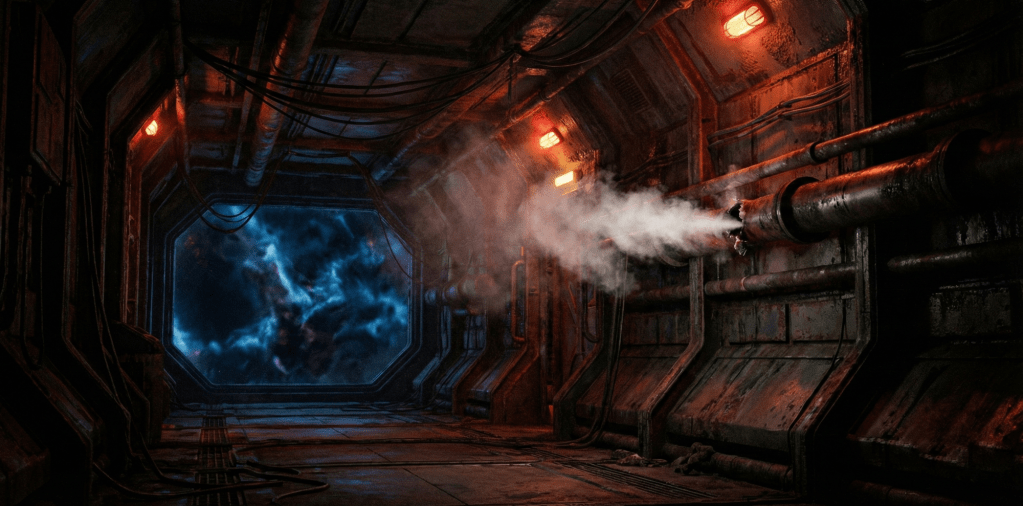
And there was gas venting. A tiny, invisible jet of oxygen or nitrogen escaping the strut’s pressurization line. The “scream” had been the gas vibrating through a microscopic fissure in the metal, resonating against the suit’s audio pickup when she stood close enough.
“I found the source,” Tyler said, her voice dropping to a flat, technical drone. She preferred this mode. It hid the shaking in her hands. “We have a leak on the starboard gear. Pneumatic line. It’s… vented.”
“Copy that. Assessing impact on ascent capability.”
Tyler didn’t wait for them. She knelt down, the suit joints protesting with a grind that vibrated through her shin. She ran a gloved finger near the gash—not touching it, just close enough to feel the faint displacement of vacuum.
“It’s weird, Houston.”
“Define weird.”
“The metal… it’s scored.” She squinted. The lights from her helmet caught the edges of the tear. There were grooves. Parallel grooves. “It looks like scratches. Three of them.”
“Scratches? From the landing?”
“No.” Tyler swallowed. The spit in her mouth tasted sour. “The landing would have compressed the strut vertical. These are horizontal. Like something swiped it.”
She looked down at the dust around the pad. It was disturbed. Not just by the engine blast. There were drag marks. Small ones. Like someone had dragged a heavy chain through the powder.
A cold prickle started at the base of her neck and crawled down her spine. She stood up, turning slowly, scanning the horizon. The shadows in the crater were absolute. Ink-black pools that could hide a skyscraper or a bottomless pit.
“Houston,” she said, “how long until the sun angle changes? The shadows are… moving.”
“Sun angle is constant for the next six hours, Tyler. You have plenty of light.”
“They’re moving,” she insisted. She wasn’t looking at the readout anymore. She was looking at a rock formation about fifty yards out. A pile of boulders that looked like a broken teeth. One of the shadows detached itself from the base of the rock.
It didn’t glide. It skittered. A jerky, staccato movement, like a spider on a hot skillet.
“Tyler, your heart rate is 140. We are aborting the EVA. Get back in the ship.”
“You see it?” she hissed. “Tell me you see it on the cam.”
“We see nothing but rocks. Get in the ship. That’s a direct order.”
Tyler took a step back toward the ladder. Her hand fumbled for the rung. The shadow stopped moving. It was just a shadow again.
Maybe it is me, she thought. Maybe the O2 scrubber is clogged and I’m high on carbon dioxide.
She grabbed the ladder. The metal vibrated under her glove.
Thump.
A vibration from inside the ship.
She froze. The Artemis was empty. It was just a tin can full of computers and air.
Thump.
Louder this time. It came from the cargo bay. The bay she had just opened to get the flag.
“Houston,” Tyler said, and this time she didn’t care if she sounded weak. She just wanted to be home, on her couch, watching bad reality TV. “Did you cycle the cargo bay hydraulics?”
“Negative. Cargo bay is static.”
Tyler looked up the ladder. The hatch she had left open was a dark circle against the white hull.
“Something’s in the ship,” she said.
“Tyler, that’s impossible. Get back inside and seal the—”
“No! If I go in there, I’m trapped with it!”
She backed away from the ladder, her boots kicking up sprays of grey dust. The silence of the moon was gone. Now, every scratch of her suit, every beep of the console, every beat of her heart sounded like a countdown.
The shadow by the rocks moved again. And this time, it didn’t stop. It unfolded.
The Story Continues…

Tyler is trapped. The Artemis is bleeding air, the comms are dead, and the thing outside isn’t just a shadow—it’s a swarm. The ship is being eaten alive, and the only way home might be worse than dying.
This is a member-exclusive story. To read the rest (Parts 3–6) and find out what happens when the glass finally breaks, join my Reader’s Circle below.
BUTTON: Unlock the Full Story on Ko-fi



 Dreams and Reality
Leave a comment