

The FBI wanted to find a crime syndicate. Instead, they found the most efficient business model in American history.
Hey Sci-Fi Fans.
Look, today is a detour. No aliens, no deep space horror. This is strictly a “What If?” scenario.
Most of you know the deal. Friends, family, you see the photos—when I’m not writing sci-fi horror, I’m playing in Vegas. It’s my escape. The noise, the lights, sitting at my favourite slot machines trying to catch a break. It’s where I go to actually shut my brain off and relax. But you sit there long enough, you start thinking about the history of the place. Specifically 1978. So I wrote this. It’s not about the future, it’s about a past that almost happened.
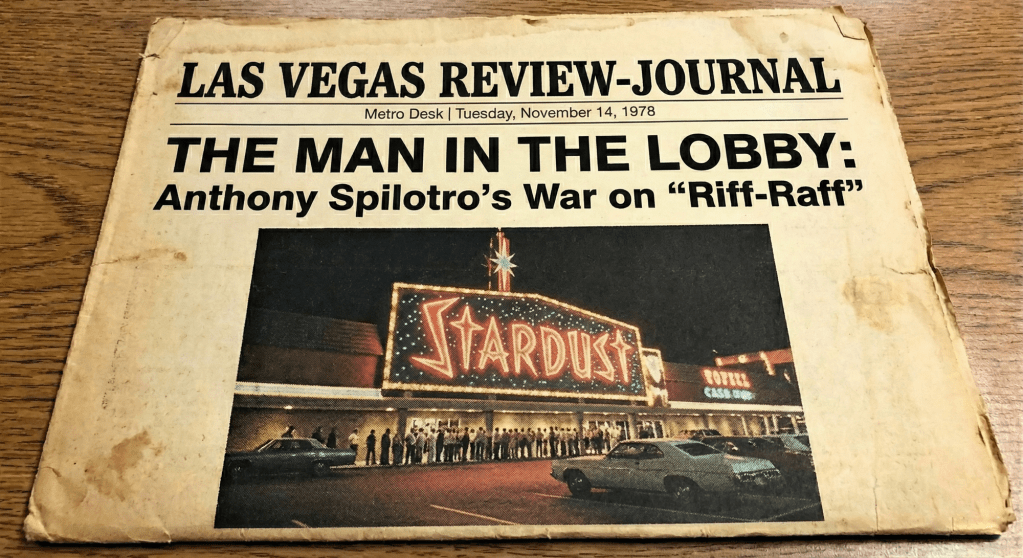
LAS VEGAS — It is 1978
The desert heat shimmers off the hoods of Cadillacs on the Strip, but inside the Stardust, the air is cold, conditioned, and smells of money. In the history books we know, this era ended in courtrooms, cornfields, and chaos. But imagine a different turn. Imagine a world where the “Chicago Outfit” didn’t send thugs to Vegas—they sent managers.
What if Frank “Lefty” Rosenthal wasn’t just a handicapper, but the most brilliant CEO America never knew? And what if Anthony Spilotro wasn’t there to break legs, but to ensure that for the first time in the city’s history, everything ran exactly on time? In this timeline, the Mob didn’t need to steal the money. They realized that if you ran the casino better than the corporations, the profits were so high that stealing became a waste of time.
Welcome to the Stardust Standard…
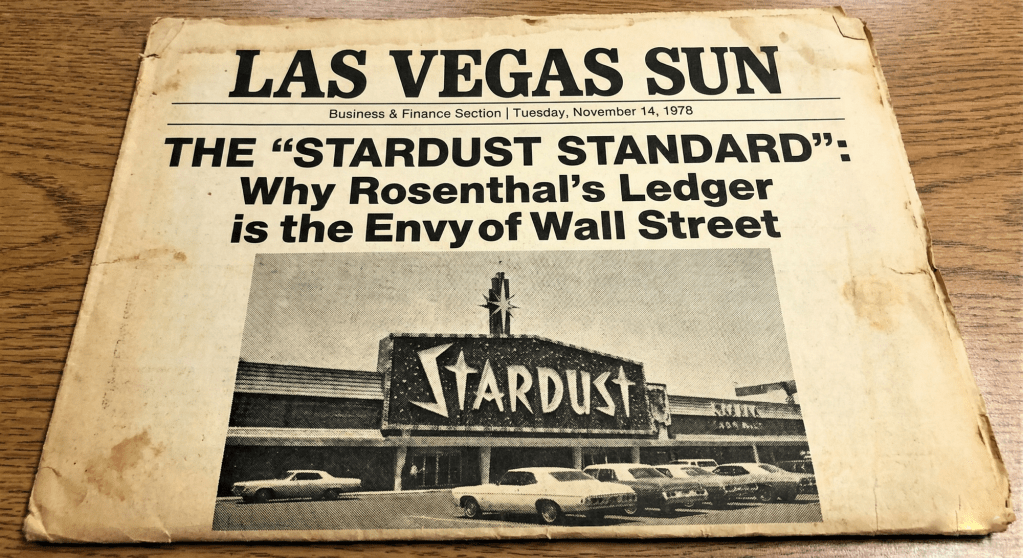
LAS VEGAS SUN
Business & Finance Section | Tuesday, November 14, 1978
THE “STARDUST STANDARD”: Why Rosenthal’s Ledger is the Envy of Wall Street
By: Hank Greenspun
LAS VEGAS — While the Hilton Corporation and the “suits” from back East struggle to understand why their profit margins are shrinking, Frank “Lefty” Rosenthal is sitting in his bulletproof office at the Stardust, putting on a clinic in American capitalism.
The State Gaming Control Board has spent months looking for irregularities in Rosenthal’s operation. What they found instead was a masterclass in efficiency that has embarrassed the MBA graduates running the corporate joints down the street.
“The corporations, they look at a buffet and see a loss leader,” Rosenthal said, meticulously adjusting his silk tie, the color perfectly matching his pocket square. “They cut the quality of the prime rib. They water down the orange juice. They save four cents and lose a customer who was ready to drop five grand at the craps table. That’s not business. That’s stupidity.”
Rosenthal’s strategy is radical in its simplicity: The House Edge is enough. You don’t need to cheat the player; you just need to keep them happy. Last quarter, the Stardust reported a 22% increase in slot handle. The secret? Rosenthal ordered every machine on the floor to be loosened to a 97% payout—three points higher than the Strip average.
“Give them a fair shake,” Rosenthal says. “They play longer. They drink more. They tell their friends. The Hilton is tightening screws to squeeze a nickel. We’re opening the floodgates to catch a dollar.”
However, the pristine efficiency of the casino floor stands in stark contrast to the chaotic rumors swirling around the executive suite. When pressed on the recent whispers—specifically that his wife, Geri Rosenthal, was seen in a heated altercation with a pit boss last Friday and had to be escorted off the floor—Rosenthal didn’t blink. He didn’t even look up from his chef’s salad.
“My wife is a passionate woman,” Rosenthal said, his voice flat, betraying nothing. “She cares about the aesthetic of this hotel as much as I do. If she sees a dealer with a frayed cuff, she gets upset. That’s not a ‘loose cannon,’ that is quality control. She demands perfection, just like I do.”
But the questions didn’t stop there. When asked point-blank about the persistent, darker rumors—that Geri has been seen frequently in the company of Anthony Spilotro, often at hours when the executive offices are closed—Rosenthal’s pen finally stopped moving.
The silence in the room lasted ten seconds. It was heavy enough to weigh.
“Let me tell you something about this town,” Rosenthal said, staring directly at the tape recorder. “People see two Italians sharing a drink and they write a script for a movie. Tony is our head of Guest Relations. He consults with my wife on… interior design choices for the high-roller suites. That is the extent of it. Geri is the mother of my children and a former dancer. She likes the nightlife. I run a 24-hour business. The only affair happening in this building is between me and the Gaming Control Board.”
He took a bite of his salad. “Next question.”
We pivoted to the recent aggressive expansion of the Summa Corporation—the legacy of the late Howard Hughes. With Hughes having bought the Desert Inn simply because he refused to check out of the penthouse, and subsequently acquiring the Sands, Frontier, and Castaways, many wonder if Rosenthal feels the pressure of the billionaire’s shadow.
Rosenthal scoffed. “Howard Hughes didn’t buy casinos to run them. He bought them to hide in them. You look at the Desert Inn today? It’s a mausoleum. They don’t know the first thing about odds. They think because they have a billion dollars, they understand gambling. They don’t. A checkbook isn’t a strategy. Let them buy the whole city. If they don’t know how to treat a player, they’re just landlords with neon signs.”
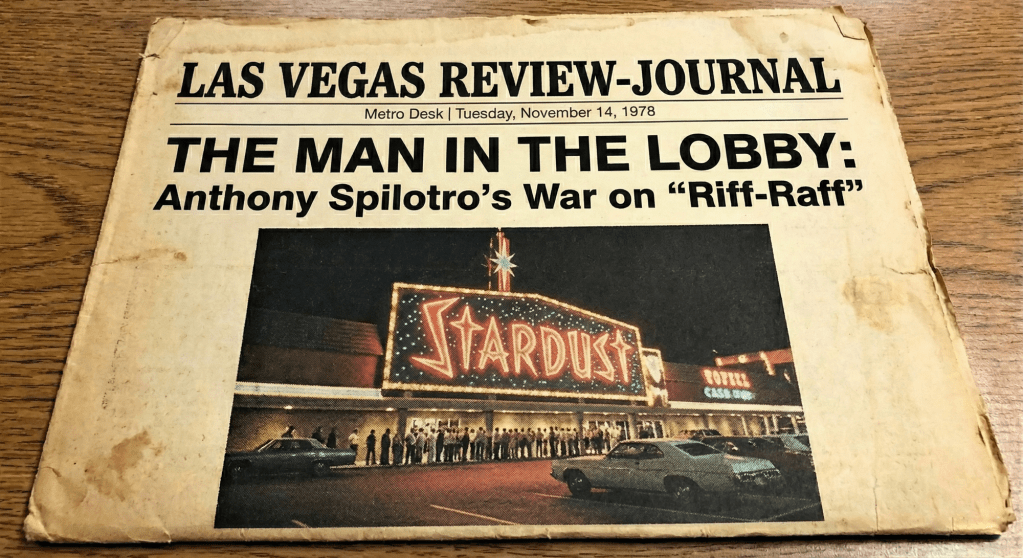
LAS VEGAS REVIEW-JOURNAL
Metro Desk | Tuesday, November 14, 1978
THE MAN IN THE LOBBY: Anthony Spilotro’s War on “Riff-Raff”
By: Ned Day
LAS VEGAS — The Las Vegas Metro Police Department is underfunded and overstretched. But on the corner of Las Vegas Boulevard and Convention Center Drive, there is no crime. There are no purse snatchers. There are no hustlers selling fake watches.
There is only Anthony Spilotro.
Listed officially as the “Director of Guest Amenities” for the Argent Corporation, Spilotro has done what three police commissioners failed to do: he cleaned up the north end of the Strip. But he didn’t do it with handcuffs. He did it with… suggestions.
“We run a family establishment,” Spilotro told the Review-Journal, standing near the valet entrance, his eyes scanning every car that pulled up. “Families don’t want to see a guy passed out in the bushes. They don’t want to be hassled. So, we make sure they aren’t.”
The “Spilotro Method” is discreet. Witnesses say that when a known cheat or a rowdy drunk enters the Stardust, they aren’t dragged out by security guards. Instead, Mr. Spilotro approaches them personally. He speaks quietly. He often puts an arm around their shoulder, like an old friend. And then, remarkably, the troublemakers simply decide to leave.
We sat down with Spilotro in the Stardust coffee shop. He was wearing a silk suit that shimmered under the halogen lights, eating a bear claw. We asked him the question the FBI has been asking for five years: Is he the Chicago Outfit’s man in Vegas? Is he the muscle behind the gloss?
Spilotro laughed. It wasn’t a nice laugh. It sounded like dry leaves crunching.
“You guys with the papers, you love the fairy tales,” Spilotro said, wiping sugar from his lip. “You ask me if I’m ‘linked’ to Chicago? That’s like asking if Frank Sinatra and Dean Martin are robbing banks just because they play tough guys on the screen. It’s a show, pal. This whole town is a show. I’m from Chicago. I like the pizza there. Does that make me Al Capone? Frank knows guys. Dean knows guys. I know guys. It’s called networking. The only ‘Family’ I care about is the one staying in Room 402 paying full rack rate for a suite.”
The conversation turned to the changing landscape of the Strip, specifically the corporate takeover initiated by Howard Hughes and his Summa Corporation. It is well known that Hughes bought the Desert Inn on a whim because he didn’t want to vacate his room, and then proceeded to buy up the Silver Slipper just to move its neon sign because it shined in his bedroom window.
We asked Spilotro if this new era of “Billionaire whimsy” bothered him.
Tony’s expression darkened. He looked out the window toward the Desert Inn across the street.
“It bothers me because it’s sloppy,” Spilotro said, his voice dropping an octave. “Hughes? He was a tourist with too much money. He bought the Desert Inn because he was cranky? That’s not business. That’s a temper tantrum. Now you got these ‘corporations’ running the Sands and the Castaways. They run ‘em like department stores. No soul. No respect.”
He leaned in, tapping a manicured finger on the table.
“You can’t run this town from a boardroom in Houston or New York. You gotta be on the floor. Hughes hid in a dark room for ten years. Me? I’m right here. I see everything. That’s the difference. They buy hotels to play Monopoly. We run hotels to make money. And let me tell you, when the ‘corporations’ have a problem with a cheater, they call a lawyer. When I have a problem…”
Spilotro paused, smiling a smile that didn’t reach his eyes.
“…I call a meeting. And we solve it.”
“One last question, if you wouldn’t mind.”
“Go ahead,” Spilotro says, checking the heavy gold links of his Rolex President. He doesn’t look up.
“Well,” the reporter stammers, shifting in the booth. “There is another rumor persisting. The federal grand jury is using the word ‘skimming’ in their—”
Spilotro cuts the air with his hand. The motion is sharp, like a cleaver hitting a block. The noise in the coffee shop seems to drop away.
“Listen. Let’s make this clear. ‘Skimming’ is a word for amateurs. It’s for busboys stealing quarters from a tip jar. It implies leakage. It implies that I don’t know where every single penny in this building is.”
He leans across the table. The smell of his cologne—musk and antiseptic—is overpowering.
“We don’t skim. We audit. You see the blueberry muffins in that display case? I know there are exactly twelve blueberries in each one. Not eleven. Not thirteen. Twelve. Because I counted them. If the books at the Stardust are showing numbers the Feds can’t believe, it’s not because we’re taking off the top. It’s because for the first time in the history of this town, nobody is stealing from the bottom. I plugged the holes, pal. The Feds are just mad that a guy from Chicago can count better than a guy from the IRS.”
Spilotro stands up, buttoning his jacket. The interview is over.
“Write that down. We don’t need to steal. We just stopped letting everyone else steal from us.”
Bari Marcus Anthony — Author & Enthusiast of the Classic Las Vegas Era




 Dreams and Reality
Leave a comment