Author’s Note
This next story was born from my obsession with Quantum Immortality – a wild, haunting hypothesis tied to the Many-Worlds Interpretation of quantum mechanics. Hugh Everett III dared to imagine it first: that the universe never collapses into a single, tidy outcome. Every quantum choice, every fork in reality , life or death, joy or sorrow. It splits the cosmos into branching paths. Every possibility lives. Every version of us keeps breathing somewhere.
To me, it’s not cold mathematics. It’s hope wrapped in fire. It means the ones we lose are never truly lost. They’re still laughing, still reaching, still here in timelines running parallel to our own. It means the fall doesn’t have to be the end. It means even the loneliest genius, centuries ahead and aching for connection, is never truly alone. We are all flickering lights, repeating the same heartbeat across an infinite hall of mirrors… and that truth both breaks me and sets me free.
Please enjoy my latest story that keeps us wondering…
Quantum Déjà Vu
The TED stage in Calgary had been a graveyard for his ego.
Ragnar Solberg had stood before the assembly not as a speaker, but as a prophet. His formula — a cascading series of tensors and non-Euclidean manifolds — was plastered across the screens behind him. To Ragnar, it was as simple as basic arithmetic. To the audience, it was the rambling of a madman. When the questions began patronizing, simplified, riddled with the dull caution of men who lived in the shallow end of physics. Ragnar didn’t answer. He stared at them with a pity so profound it felt like a physical blow.
“You are arguing over the ripples,” he whispered into the microphone, his voice dripping with icy contempt, “while I am standing at the source of the flood. You lack the architecture to even perceive the shape of what I’ve found.”
He walked off stage mid-question, leaving his life’s work. The Quantum Déjà Vu theory discarded like a failed experiment.
The Escape to Johnston Canyon
Frustration still burned behind his eyes as he drove west. By the time he reached Banff, the sun was sinking behind the jagged peaks of the Rockies, painting the sky in colours that felt garish and wrong. He needed to be small. He needed to be unreachable.
He went to the Upper Falls of Johnston Canyon. As a free solo climber, he didn’t use ropes; they were for people who didn’t trust their own nervous systems. He gripped the limestone, his fingers finding purchase on edges the size of a razor blade. He climbed with a savage, rhythmic precision, his mind replaying the faces of the “fools” in Calgary. He was so busy dissecting their incompetence that he forgot the cardinal rule of the wall: the rock does not care about your genius.
His foot slipped on a patch of black ice.
It wasn’t a long fall, but it was absolute. Ragnar hit the water of the pool below with the force of a falling anvil. The cold was a violent, suffocating shock. He was sucked into the subterranean eddies — the “churn” — where the water ground against itself like stone teeth. He fought, his brilliant mind frantically calculating the hydrodynamics of his escape, but the current was chaos, and chaos is the enemy of calculation.
His lungs burned, then went numb. The light in his eyes flickered, dimmed, and vanished.
The Shift
Twenty minutes later, he didn’t wake up. He resumed.
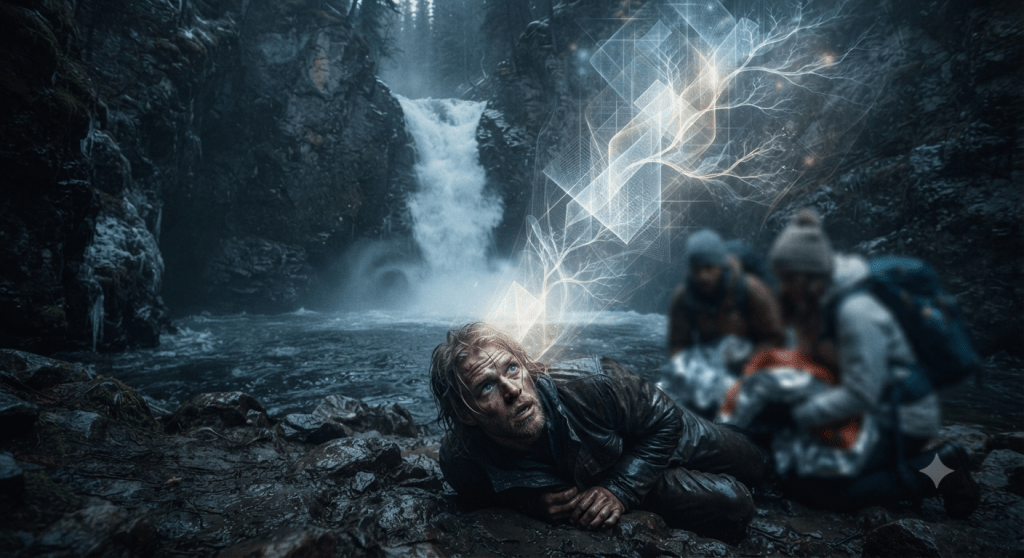
He gasped, a violent, guttural sound, and arched his back on the muddy bank. A pair of hikers stood over him, terrified. He had been clinically dead. His body was cold, blue, and ruined.
Ragnar looked at his hands. They were trembling, not from the cold, but from the realization. He remembered the darkness. He remembered the cessation of his own consciousness. And then, he remembered the unmistakable sensation of his awareness being ripped from a dying thread and stapled onto a new one.
The Haunting
He returned to the world, but something fundamental had shifted. He didn’t go back to academia. He took a small cabin outside of Banff and let the mountains swallow his days.
The first time it happened, he was buying coffee in Canmore. The barista, a woman with tired eyes and a faded tattoo on her wrist, smiled like an old friend. “Your usual oat milk flat white, extra shot?” She had already started pulling the espresso. Ragnar froze. He had never been inside this shop before. Yet the déjà vu hit like a second heartbeat — he could almost taste the conversation they’d had last week, the way she’d laughed at his dry joke about Norwegian winters. When he reached for his wallet, her smile faltered for a split second, as if she too had felt the echo.
Later that same week, he sat on a bench near the Bow River. An elderly man in a red plaid jacket stopped, eyes widening in recognition. “Ragnar… I’m so sorry for your loss,” the stranger said, voice thick. His hand hovered as if he wanted to rest it on Ragnar’s shoulder, then withdrew. “She was a fighter. We all loved her.”
Ragnar’s throat closed. He had no wife, no daughter, no recent loss. But in that moment he felt the grief — sharp, second-hand, already lived. The man’s eyes glistened with tears that belonged to another timeline, another version of himself who had buried someone dear. Ragnar managed only a nod. The stranger walked away, shoulders slumped, as if he had delivered condolences he had given many times before.
He saw the Quantum Déjà Vu everywhere now. A waitress who already knew how he took his steak. A gas station clerk who handed him lottery tickets and whispered, “Better luck this time.” Each echo chipped away at the arrogant prodigy he had been. The scientists in Calgary hadn’t been stupid. They had been static, fixed points in a single, boring timeline.
Ragnar realized we don’t really die. Our awareness is simply shifted into a living timeline of ourselves. The sheer weight of that truth stopped him cold in his tracks. Oh God ! He was so incredibly lonely.
He became a ghost of the mountains. He was often seen sitting at the edge of the falls, not climbing, just watching. People would try to talk to him, but he would only offer a soft, pitying smile.
“You’re all so concerned with the destination,” he would say, his voice a low rumble that seemed to carry the weight of centuries. “You’re afraid of the end. But the end is just the door.”
The Final Legacy
Ragnar Solberg never finished his theory for the world. He kept it for himself. When he finally passed away, years later, in his sleep — a death that felt strangely mundane — they found his journals.
There were no complex equations left. Only one sentence, written over and over in the margins:
“The math was correct, but the soul is the only variable that refuses to be solved. We are all just flickering lights in an infinite hall of mirrors, experiencing the same heartbeat, the same fall, and the same glorious, terrifying Quantum Déjà Vu over and over again. I have finally stopped running. I hope you do, too.”
Ragnar had finally understood what his genius had blinded him to: that being centuries ahead of everyone else means you are, ultimately, very lonely, but being part of the infinite means you are never truly gone.
Bari Marcus Anthony



Leave a Reply