I am not a scientist, but I have spent years studying various angles of what dark matter could actually be. It turns out that what I have been picturing aligns with what several astrophysicists have proposed in their own theories. I could never test these ideas like this before AI. You cannot just pick up the phone, call a leading astrophysicist, and run your personal cosmology theories by them. Using AI, I laid out my view of dark matter, and the data showed I was tracking along the exact same lines as cutting-edge theoretical physics. As a science fiction writer, it is my job to make sure the real science holds up before I build the fiction around it.
That being said, astrophysicists like Neil deGrasse Tyson, Lisa Randall, and theoretical cosmologists worldwide agree that roughly 85% of all matter in the universe is completely invisible. We label it dark matter, but mainstream astronomy still cannot tell you what it is made of.
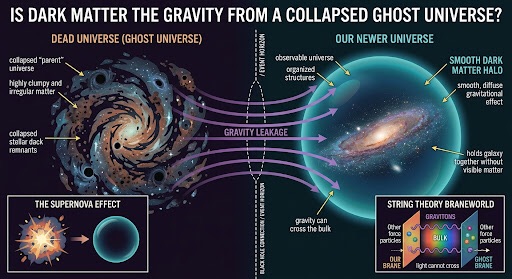
What if dark matter is not some passive cloud of mysterious dust? What if it acts as a cosmic bonding agent—gravity leaking across dimensions from an older, dead universe that collapsed on the other side of a massive black hole? And what if our universe is relatively young compared to older dimensional structures?
It sounds like high-concept sci-fi, but theoretical physicists have spent decades building mathematical frameworks around these exact concepts.
The Name: Braneworld Gravity and Bulk Leakage
In string theory, our universe is modeled as a three-dimensional membrane—a “brane”—floating inside a higher-dimensional space called “the bulk.”
Standard particles like electrons, quarks, and light photons are open-ended strings. Both ends are pinned firmly to our brane, meaning they can never leave. But the hypothetical carrier of gravity—the graviton—is a closed loop with no loose ends. It does not anchor to our slice of space. It can move freely across the bulk.
Theoretical physicists like Lisa Randall and Raman Sundrum showed that if another universe exists across that extra dimension, its gravity can bleed through to ours. We could never see its matter or shine a light on it, but its gravitational pull would reach across the void to bind our galaxies together. Physicists call this Braneworld Gravity or the Shadow Matter Hypothesis.
The Name: Black Hole Cosmology and the Big Bounce
Where does the collapsed, older universe come into play?
Standard general relativity says collapsing mass hits a point of infinite density called a singularity. Quantum cosmology rejects that infinite roadblock. Theories like Loop Quantum Cosmology propose a “Big Bounce.” When an ancient, dying universe collapses under extreme gravity, quantum pressure pushes back, triggering an outward explosion into a new spacetime on the other side of a black hole’s event horizon.
Physicist Lee Smolin formalized this as Cosmological Natural Selection (or Black Hole Cosmology). In this model, our Big Bang was the internal expansion of a black hole born from an older parent universe. Our cosmos is the newcomer, expanding outward from the core of an ancient collapse.
The Supernova Remnant Effect: Why the Halo Stays Smooth
The biggest pushback against dark matter being a dead universe is distribution. Sinking into black holes should leave jagged, irregular gravitational knots, whereas observed dark matter forms giant, smooth spherical halos around galaxies.
The answer lies in how violent, high-energy collapses behave.
Look at a massive star explosion. When a star goes supernova, the violent detonation blows away chaotic asymmetries, pushing outward into an expansive, incredibly smooth spherical shockwave. A collapsing parent universe undergoing a Big Crunch and bounce does the exact same thing on a cosmic scale.
The compression homogenizes all matter down to the Planck scale, wiping out previous clumps. When it rebounds outward, that shockwave expands symmetrically. By the time that gravitational imprint bleeds through higher dimensions onto our brane, it diffuses into a uniform, seamless sphere—producing the exact smooth dark matter halo holding our galaxies together today.
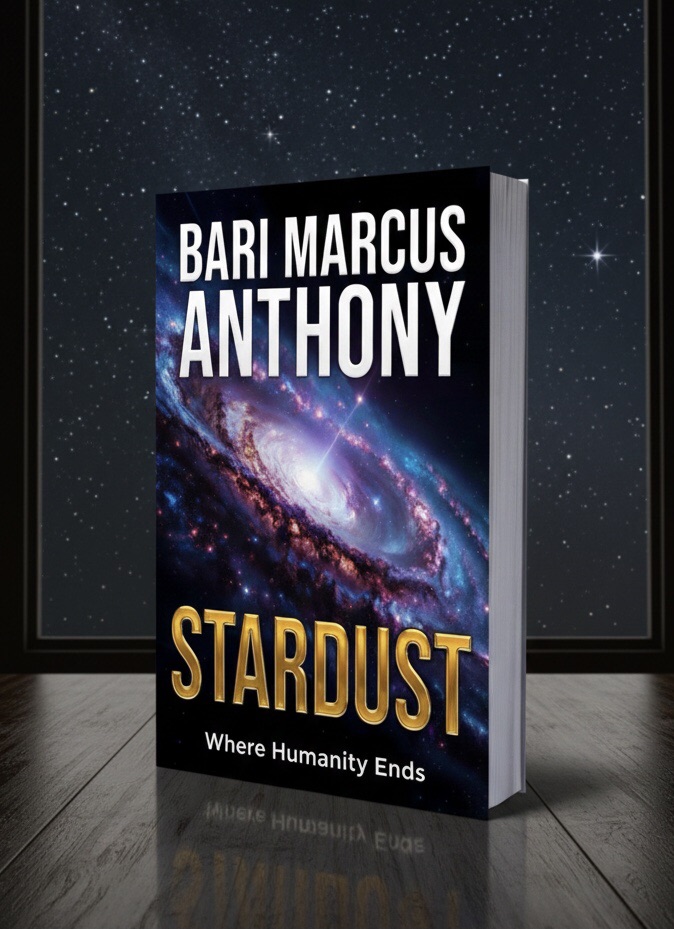
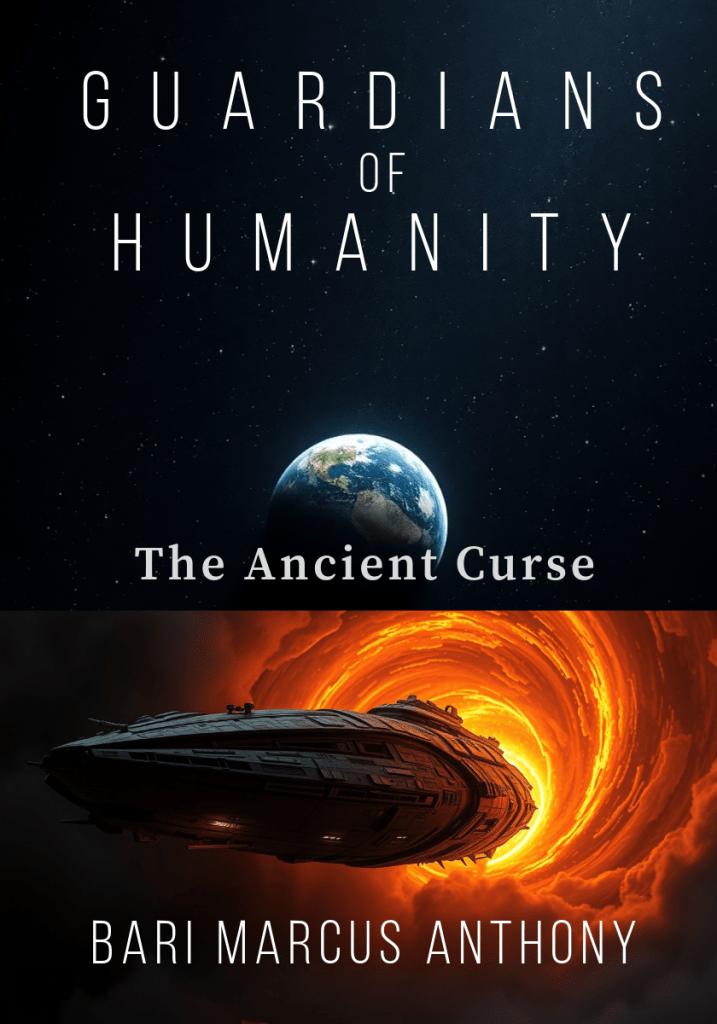
As a science fiction writer I have a duty or responsibility to make sure the science is right. This is evident in my novels, “ Guardians of Humanity “ and “ Stardust “.
Before I crafted a single storyline, the real astrophysics came first.
If you want science fiction that builds on the actual mechanics of extra dimensions, cosmic shockwaves, and the survival of our species against impossible odds, dive into my books:
Guardians of Humanity: When the boundaries of space and survival are pushed to the brink, humanity must confront the true scale of what lurks beyond our dimensional horizon.
Stardust: A hard-hitting collection of short science fiction and fantasy tales exploring the razor-thin line where known physics ends and cosmic mystery begins.
Both are available now on Amazon—grab your copy and see where the real science leads. 👇
Bari Marcus Anthony



Leave a Reply