
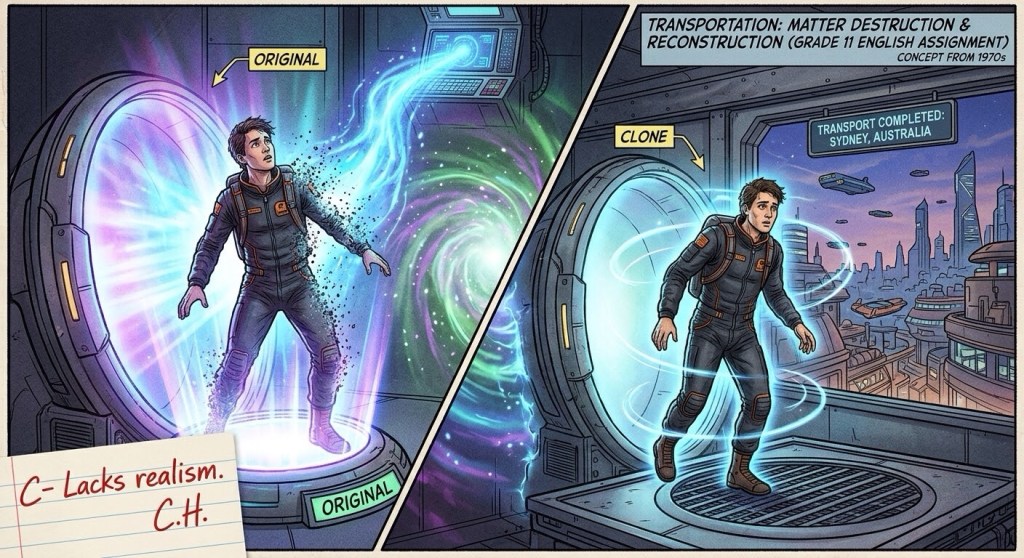
Stepping into a glowing booth and instantly popping up on another planet looks cool on TV, right? It’s clean, fast, and nobody ever asks how it actually works.
Except I did, back in the early 1970s when I was sitting in Grade 11 English at VSS.
I wrote a short story about teleportation—my very first science fiction story, written out on paper for an English assignment ; and I got docked all the way down to a C-. The red-ink note at the top of the page said my story suffered from a “lack of realism.” Even at sixteen, sitting at a scarred wooden desk that smelled faintly of pencil shavings and stale chalk dust, that grade burned.
Here is what I actually wrote: you can’t just magically zap a human body across the universe like a text message. Matter doesn’t work that way. To get from Point A to Point B, the machine has to scan your exact atomic blueprint, vaporize your original body into raw data, and 3D-print an identical biological copy at the destination.
Which means every single time you step into that booth, you die. A clone with all your memories walks out the other side, completely unaware that the “real” you just got erased.
My teacher hated it. Told me it didn’t make sense.
Fast forward fifty years, and pop culture and modern physics finally caught up. Even Star Trek: The Next Generation eventually tackled the dark side of the transporter in the episode “Second Chances.” When Commander Riker tried beaming off a planet through a massive energy distortion, the beam split—rebuilding one copy of him back up on the ship while leaving the original Riker stranded down on the surface for eight years. Major Hollywood movies like The Prestige and shows like Black Mirror have also built massive, mind-bending plots around that exact horrifying dilemma.
What my teacher called “unrealistic” is actually one of the darkest, most scientifically grounded concepts in hard science fiction.
If you’re writing stories right now, or sketching out weird ideas in the margins of your notebooks, take this as a warning. Sometimes the adults grading your work are stuck in the past. When you push past the easy, magical answers and look at the cold, hard mechanics of how things really break down, people might tell you you’re wrong.
Keep writing it anyway. And never throw away your rough drafts.
Bari Marcus Anthony


Leave a Reply