Most of my blogs are related to science fiction. That being said, I would like to add to my Reality Page, where I write about real experiences and thoughts.
First and foremost, I would like to mention that I spend a lot of my time writing science fiction to introduce you to my novels, Guardians of Humanity and Stardust.
But — today is different.
Remembrance Day and the Toll of Our Military
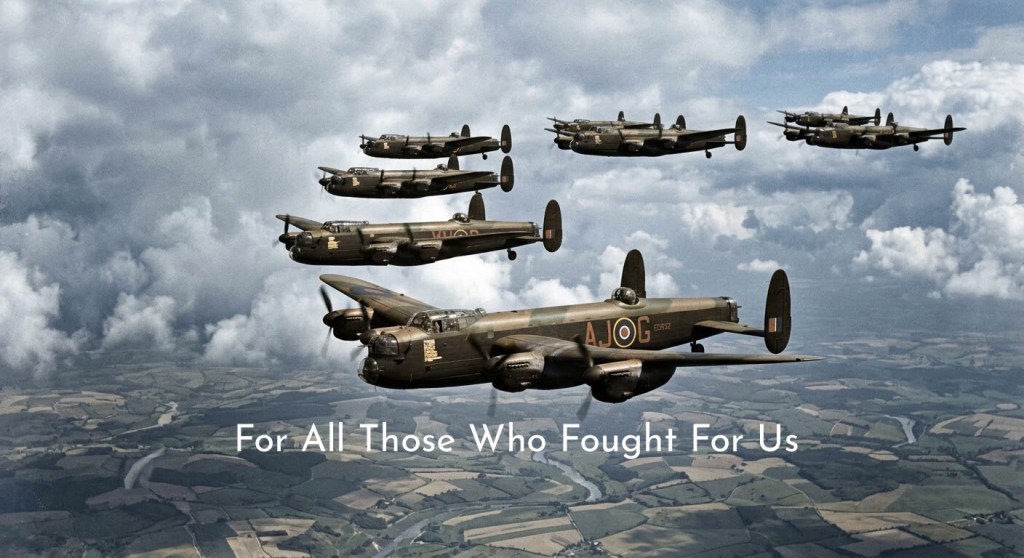
I would like to write about my Uncle Marcel, a military man who fought in WWII. He was a Bombardier on board the Avro Lancaster; officially known as the Bomb Aimer (or Air Bomber) with the Royal Canadian Air Force (RCAF).
Marcel enlisted around 1943 with the RCAF and was immediately shipped to England, beginning his training before entering the war. He wanted to be a pilot, but instead they noticed his skills in perfectionism. His officer encouraged him to become a Bombardier instead.
Apparently, it was a big deal to become an Air Bomber; because the Lancaster carried a crew of seven with no co-pilot, the Bomb Aimer was one of the busiest and most versatile trades on board, wearing a single-wing brevet with the letter “B” on their uniform. He was proud of his “B” on his uniform.
Unlike most —
My uncle liked to joke a lot, and I believe that rubbed off on me because I, too, like to add humour into our lives; hence Bigfoot Harry. During the war, Uncle Marcel used his humour to keep the morale up for his crew. But unfortunately, all the jokes in the world wouldn’t help them the day they took flight over Germany. Apparently, it was their last run before heading back to England—a massive air strike to help end the war and crush Hitler’s regime.
He barely would talk to me about it, but all he said was — on this night, things went south. His Avro Lancaster was hit with all seven aboard. My uncle told me everything was like it was in slow motion; one minute they were cracking jokes, the next their plane spiralled precariously towards the ground. The pilot did everything to keep this bird level, but eventually nothing could save them from disaster. They crashed into an open field. All he remembers from that point on is someone helping him out of the burning craft. Later — he learned he was the only survivor.
After that fateful day, Uncle Marcel said everything changed. He was never the same person. Back then, PTSD wasn’t really labeled. The clinical term Post-Traumatic Stress Disorder (PTSD) did not exist during WWII—it wasn’t officially recognized by the psychiatric community until 1980 (following the Vietnam War).
However, that being said —
Military doctors and commanders in the RAF, RCAF, and Allied forces were acutely aware of the psychological toll of combat. They simply called it by different names, and treated it with a mix of genuine medical insight and harsh military discipline.
For the rest of the war, Uncle Marcel was in the hospital recovering from his injuries and the loss of his crew. It took a toll on him that many servicemen and women unfortunately experience today.
Anyway —
This blog is for my Uncle Marcel, who’s no longer with us today. Thank you for your service and for protecting our freedom.
I would also like to mention and thank all the servicemen and women, including our allies, who have fought to keep us free.
Cheers, Uncle Marcel!
Bari Marcus Anthony
PS – Shout out if you serve or served in the military…


Leave a Reply